
Small-Lot Hazard Due Diligence | Why Small Lots Still Need Big Due Diligence
Author
LandSentry Admin
Date Published

readTime: "9 min read" featured: true excerpt: "Small lots can inherit big risks. Learn how flooding, drainage, and subdivision design affect housing-scheme properties." coverImage: "/api/media/file/House_in_flooding_area.png" tags:
- Housing Schemes
- Flood Risk
- Due Diligence
- LandSentry
- Jamaica Real Estate
- Drainage
- Property Risk
- Diaspora Buyers
Why Small Lots Still Need Big Due Diligence
How LandSentry helps Jamaican housing-scheme buyers understand drainage, flooding, slope and subdivision-scale risk before they buy
Core message: Natural hazards do not stop at a 1/4-acre boundary. A small housing-scheme lot can inherit risk from the whole subdivision: roads, gullies, slopes, drains, fill, common infrastructure and upstream runoff.
A small lot can still sit in a large hazard system
A quarter-acre lot can feel “small enough to be simple.” In a typical Jamaican housing scheme, the buyer may assume that because the roads, drains, lots, sidewalks and house pads were laid out by a developer, the risk has already been solved.
That assumption can be expensive.
Natural hazards do not stop at lot boundaries.
- Floodwater does not care that your parcel is only 1/8 acre.
- Storm runoff does not follow a sales brochure.
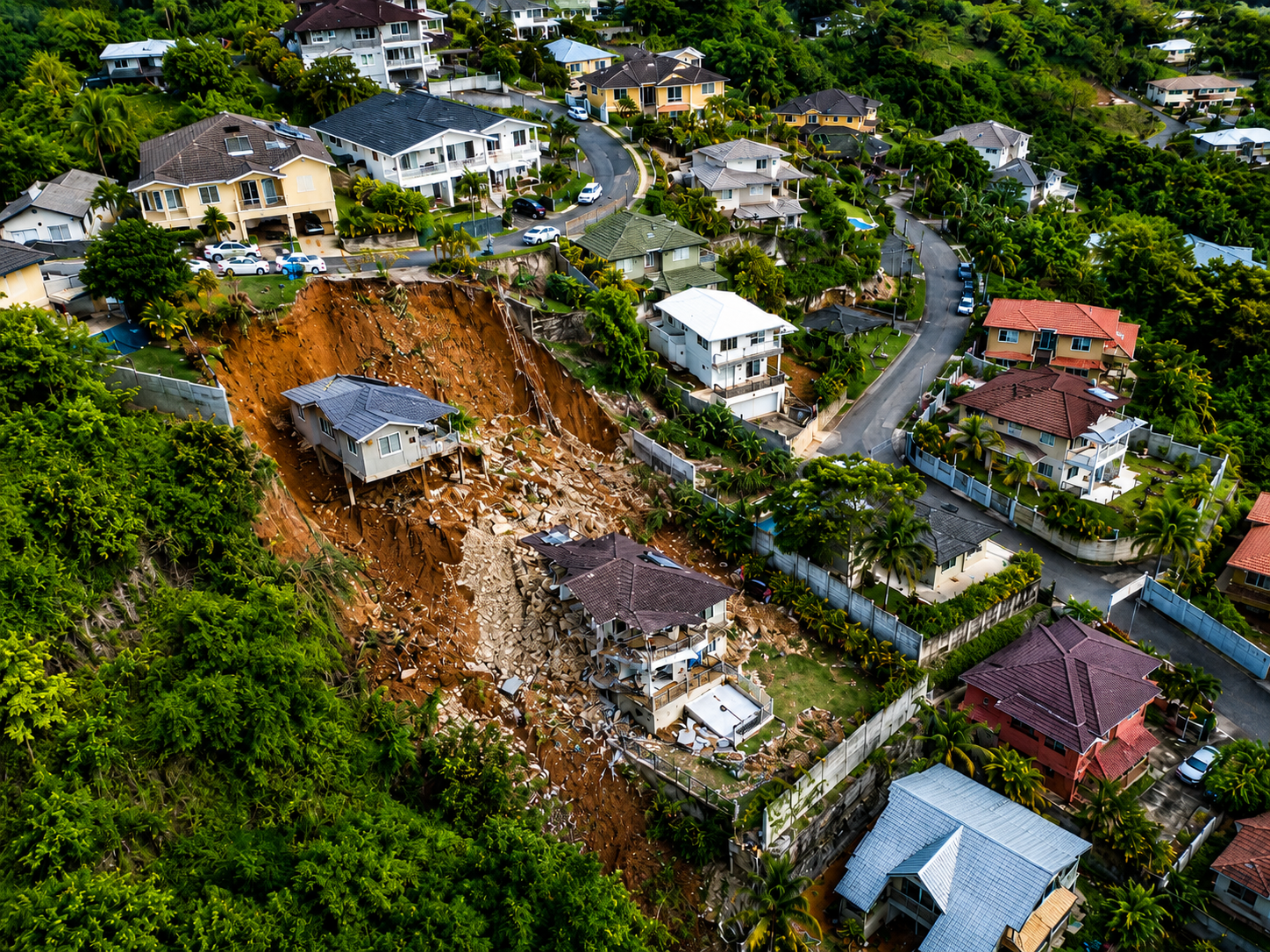
- Landslide risk does not disappear because a house is in a planned community.
In Jamaica, a buyer can have a clean title, an attractive home, paved roads and a gated entrance, yet still discover after purchase that the lot sits in the path of subdivision drainage, beside an undersized gully, at the bottom of a slope, in a low pocket, or on a road segment that becomes impassable after heavy rain.
That is why LandSentry’s LIFT™ and CLEAR™ products are not only for large acreage, farms, villas or development land. They are also valuable for small residential lots, townhouses and homes in housing schemes, especially when the buyer lives overseas and cannot easily read the land for themselves.
The mistake: judging only the house, not the whole subdivision
Most home buyers focus on the building:
- bedrooms,
- finishes,
- parking,
- title,
- mortgage,
- price, and
- proximity to work or family.
Those things matter.
But in a subdivision, the performance of your individual lot depends heavily on the entire subdivision parcel.
A house may be fine, but the subdivision layout may push stormwater toward one corner.
- One street may sit lower than the rest.
- One row of houses may back onto a gully, drainage reserve or filled lowland.
- One phase of a scheme may be more exposed than another.
- One entrance road may cross a flood-prone channel.
- One block may receive runoff from roofs, yards, internal roads and surrounding hillsides.
That means a buyer should not only ask, “Is this house good?”
The better question is: Where does this lot sit inside the drainage, slope, access and hazard system of the entire scheme?
That is the LandSentry advantage.
Caribbean context: flooding is often a drainage-system problem
Most countries’ public disaster guidance identifies several main causes of flooding, including:
- heavy rainfall from tropical weather systems,
- inadequate drainage-channel design,
- inadequate maintenance of drainage facilities,
- blockage by debris, and
- construction of settlements in flood plains.
They also note that flooding is a natural feature of drainage systems and rivers and streams.
For a housing-scheme buyer, this is critical.
Flood risk is not only about whether a river is nearby.
It may be about where stormwater goes after intense rainfall hits:
- roofs,
- roads,
- yards,
- paved driveways, and
- nearby slopes.
The more land is paved or roofed, the faster runoff moves.
If the drains are undersized, blocked, poorly graded or discharging through the wrong route, the low lots receive the consequence.
This is why a whole-subdivision analysis can be more valuable than a narrow lot-only review.
A buyer does not need a 10-acre estate to benefit from GIS, drainage mapping and hazard screening.
A 1/4-acre lot may be exactly where precision matters most.
Jamaican example: OceanPointe, Hanover
A recent Jamaican example is the flooding at the OceanPointe Housing Development in Hanover.
The Jamaica Gleaner reported that flooding in Phase Five and Phase Six left several homes submerged, with at least five homes sustaining significant damage to furniture, household items and infrastructure.
Television and social media reports also described residents at Ocean Point/OceanPointe as traumatised after severe flooding.
The planning lesson is powerful: in a housing development, the buyer’s risk may not be obvious from the front elevation of the house.
The critical information may be in the:
- site grading,
- drainage reserve,
- gully capacity,
- roadway slope,
- low points,
- upstream runoff, and
- phase-by-phase drainage layout.
A LandSentry review would not guarantee that a property will never flood.
But it could help a buyer ask the right questions before purchase:
- Is this lot in a low phase of the scheme?
- Does the road slope toward the house?
- Is the lot near a gully, detention pond, culvert or drain outlet?
- Are there signs of previous ponding or water staining?
- Do surrounding lots and roads drain toward this block?
- Is the scheme entrance itself vulnerable to flooding?
- Are nearby drains open, maintained and adequately sized?
- What did recent local news, resident videos and storm reports show?
What LandSentry would analyze for a small lot
For a small residential parcel, LandSentry’s value is not that the lot is physically large.
The value is that the lot is part of a larger physical system.
Subdivision position
Is the lot at the high point, midpoint or low point of the scheme?
A house near the low end of a subdivision may collect water from roads and upstream lots.
Drainage pathways
Where does stormwater likely flow during heavy rainfall?
Roads often become temporary drains.
A lot at an intersection, bend, cul-de-sac low point or road sag may be more exposed.
Nearby gullies and channels
Is the property beside a formal drain, natural gully, culvert, stormwater outlet or filled channel?
These features may be dry during a showing but active during storms.
Slope and retaining walls
Even in housing schemes, some lots are cut into hillsides or filled along slopes.
Retaining walls, cracked pavement, leaning fences or steep backyards can indicate future repair exposure.
Flood-prone access
The house itself may stay dry while the access road floods.
That still matters for:
- emergency access,
- work commute,
- school access,
- insurance,
- tenant appeal, and
- resale.
Coastal and hurricane exposure
In coastal schemes, drainage combines with:
- storm surge,
- wave setup,
- high groundwater, and
- wind-driven rain.
Even where storm surge is not the main issue, blocked drainage during a hurricane can create severe local flooding.
Fill and ground settlement
Some subdivisions are built on:
- filled lowlands,
- reclaimed wet areas,
- old drainage corridors, or
- variable ground.
Buyers should know whether there are settlement cracks, poor compaction clues or ponding patterns.
Offsite contributors
The source of the problem may be outside the scheme:
- hillside runoff,
- blocked gullies,
- upstream development,
- road drainage,
- deforestation, or
- nearby construction.
How drainage maps help buyers select lots
Drainage mapping is one of the clearest examples of why LandSentry pays off for small lots.
Imagine a scheme where the houses are priced similarly.
Lot A, Lot B and Lot C may all be 1/4 acre.
The houses may look almost identical.
But a drainage analysis may show that:
- Lot A is on a gentle crown and drains away from the house;
- Lot B is at the bottom of a road grade and receives runoff from two streets; and
- Lot C backs onto a gully with erosion signs and a blocked culvert downstream.
The buyer looking only at the house might choose based on kitchen finishes or paint color.
The buyer using LandSentry might choose the lot with lower long-term risk — or negotiate a lower price for a higher-risk lot.
That can save money in several ways:
- avoided water damage,
- avoided mold cleanup,
- fewer drainage repairs,
- better insurance discussions,
- less disruption after storms,
- stronger resale confidence, and
- fewer surprises after moving in.
Other LandSentry use cases for housing-scheme buyers
Choosing between lots in the same development
A developer or realtor may show several homes in the same scheme.
LandSentry can compare them by:
- elevation,
- drainage,
- access,
- nearby drains,
- slope,
- road position,
- gully proximity, and
- hazard exposure.
The “best” lot may not be the newest or prettiest; it may be the one with the safest physical setting.
Checking a resale home before offer
For an existing scheme home, LandSentry can review:
- satellite imagery,
- street context,
- local news,
- visible drainage patterns,
- road grades,
- nearby watercourses, and
- signs of past flooding.
A buyer can then ask the seller targeted questions:
- Has water ever entered the yard?
- Did the road flood?
- Were drains recently cleaned?
- Was any wall repaired?
- Were claims made after storms?
Avoiding the “cheap lot” trap
Sometimes the lowest-priced lot is low for a reason.
It may sit:
- near a drain,
- below a slope,
- at a road sag,
- beside a gully,
- near unstable fill, or
- in a phase with repeated flooding complaints.
A LandSentry review can help determine whether the discount is a bargain or a warning.
Protecting mortgage and insurance decisions
Extreme weather affects housing markets.
Research on Jamaica’s housing market has examined how extreme rainfall and hurricanes affect real estate and housing finance, reinforcing why buyers should understand hazard exposure before committing to a purchase.
Understanding common-area risk
In schemes, common drains, culverts, gullies, entrances, boundary walls and detention areas may affect everyone.
A buyer should know whether:
- the scheme’s main entrance is flood-prone, or
- the lot depends on common infrastructure that may not be maintained.
The home may be private, but the hazard system is shared.
Supporting negotiation
LandSentry findings can provide negotiation leverage.
If the lot:
- is near a drainage channel,
- has ponding indicators,
- sits below road grade, or
- depends on a vulnerable access road,
the buyer can request:
- a price adjustment,
- drainage repairs,
- engineer review,
- seller disclosure,
- escrow holdback, or
- a walk-away option.
Why this matters especially for diaspora buyers
Many diaspora buyers are trying to purchase from abroad.
They may see:
- videos,
- realtor photos, and
- family WhatsApp clips.
But those rarely show the property during heavy rainfall.
They rarely show:
- the drainage route behind the wall,
- the road low point,
- the gully behind the scheme, or
- the stormwater outlet at the end of the block.
LandSentry helps close that information gap.
A diaspora buyer can send:
- the listing link,
- Google Maps pin,
- scheme name,
- lot number if available,
- intended use, and
- any survey or title information.
LandSentry can then review the lot in context, not isolation.
That gives the buyer a clearer basis to proceed, pause, renegotiate or request specialist review.
LIFT™ vs CLEAR™ for small lots
LIFT™
For a small housing-scheme lot, LIFT™ is the practical first step.
It is a desktop screen that can review:
- location,
- terrain,
- drainage clues,
- access,
- nearby hazards,
- imagery,
- public-source information, and
- a risk summary.
CLEAR™
CLEAR™ is appropriate where the purchase decision needs stronger verification.
That may include:
- a drive-by field check,
- drone imagery where lawful and practical,
- drainage photos,
- local interviews,
- boundary confirmation,
- deeper review of scheme layout, or
- coordination with survey/engineering professionals.
The point is not to overcomplicate a small purchase. The point is to match the review to the risk.
A low-risk flat urban lot may only need a light screen.
A low-lying coastal lot, hillside scheme lot, gully-adjacent lot or repeatedly flooded community may justify a deeper review.
The return on investment
The cost of due diligence is small compared with the potential cost of choosing the wrong lot.
A flooded house can mean:
- damaged furniture,
- mold remediation,
- electrical repairs,
- blocked access,
- lost rental income,
- insurance disputes,
- reduced resale confidence, and
- emotional stress.
A lot with hidden drainage or slope risk may require:
- grading,
- drains,
- retaining walls,
- pumps,
- culvert repairs, or
- repeated maintenance.
For a buyer, the best return is often not dramatic.
It is quiet confidence:
- selecting the safer lot,
- avoiding the wrong phase,
- negotiating before closing, or
- walking away before money is locked in.
The LandSentry message
Small lots still deserve serious due diligence because natural hazards operate at the subdivision scale.
In Jamaica, a housing-scheme home is not just a structure; it is part of a drainage basin, road network, slope system and community infrastructure pattern.
Before buying a house in a Jamaican housing scheme, do not only ask whether the title is clean and the kitchen is nice.
Ask:
- where the water goes,
- where the road floods,
- what sits uphill,
- what sits downhill, and
- what happened in the last heavy rain.
LandSentry helps buyers answer those questions before they commit.
Before you buy
Send LandSentry:
- the listing link,
- scheme name,
- lot location,
- Google Maps pin,
- intended use, and
- any plan or survey you have.
Start with LIFT™ for a fast risk screen.
Use CLEAR™ when drainage, flooding, slope, access or subdivision layout could determine whether the home is a smart purchase or an expensive surprise.